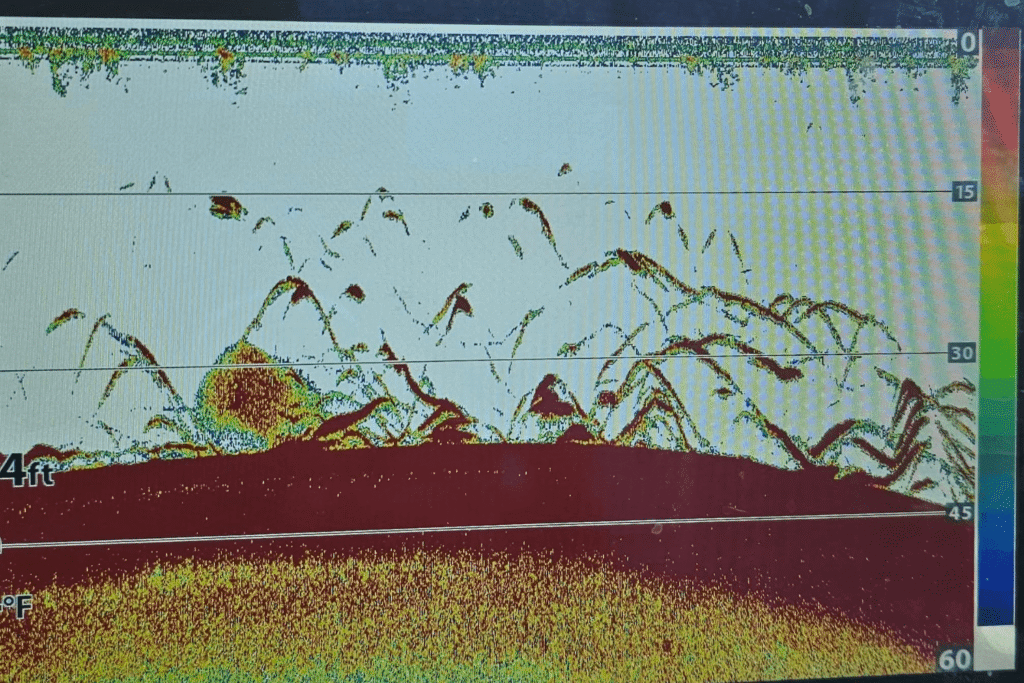
2D sonar shows you a history of what passed under the transducer, with the newest data on the right side of the screen.
1. Colors = Signal Strength
Different brands use different color palettes, but the rules are always the same:
Strong returns (dense objects):
- Red / Orange / Yellow
- Hard bottom, rock, big fish, thick bait.
Medium returns:
- Green
- Softer bottom, smaller fish, lighter bait.
Weak returns:
- Blue / Light blue / Gray
- Soft bottom, mud, plankton, debris.
Tip: Big fish usually show as thicker, darker arches because they reflect more sonar energy.
2. Fish Show as Arches
Why? Because the fish enters the cone, gets closest to center (peak of the arch), then leaves.
A fish arch tells you:
- Width of the arch = how long the fish was in the cone (not its size)
- Thickness/color of the arch = size of the fish
- Height of the arch = how close the fish was to the transducer
Full arch vs half arch:
- Full arch = fish passed through center of cone
- Half arch / checkmark = fish passed along edge of cone
- Dot / line = fish stayed still or your boat moved slowly over it.
3. Bottom Reading
The bottom line tells you a LOT.
Hard bottom:
- Thick, bright line (reds/yellows)
- May show a 2nd or 3rd return
Soft bottom:
- Thin, pale line (green/blue)
- No secondary return
Transitions matter (fish love them):
- Hard → soft
- Soft → hard
These show as a color/line thickness change.
4. Identify Bait Balls
Bait shows as:
- Clouds, blobs, cotton candy, or clusters
- Usually yellow/green
- May have predator arches around or below them
If predators are feeding, you’ll see:
- Arches streaking through bait
- Vertical lines (chasing upward)
5. Surface Clutter & Thermocline
Surface clutter:
- Fuzzy band in the top 1–5 ft—ignore it.
Thermocline (temperature layer):
- Shows as a solid horizontal line or haze mid-water.
Fish often suspend right above it.
6. Speed Affects Fish Arches
Moving too fast = long arches
Moving too slow = short or no arches
Best speed = 2 – 10 mph for structure scanning, slower (1 – 5 mph) for finding fish staying still.
7. Cone Angle Matters
2D sonar sends a cone-shaped beam.
- Wide cone = more area, less detail
- Narrow cone = more detail, less area
A fish may show deeper than it really is if it’s off to the side of the cone.
🎯 How to Practice Reading It
Turn your sonar on while:
- Idling over points, humps, drop-offs
- Drifting over known brush piles
- Trolling slowly while watching bait
Take screenshots and compare what you see to where fish actually are.